

Neuromeditation: Bridging Mindfulness and Neurofeedback for Measurable Mental States
Introduction: Where Mindfulness Meets Measurement
Neuromeditation training is changing the way you approach meditation by turning what was once subjective into something you can actually observe and refine in real time. If you have ever sat down to meditate and wondered whether you were doing it “right,” you’re not alone. Traditional meditation asks you to trust your internal experience, yet offers very little feedback on whether your brain is truly entering the desired state.
At the same time, advances in neurofeedback have made it possible to monitor brain activity with remarkable precision, giving you access to data that was once limited to research labs. When these two worlds meet, something powerful happens. Neuromeditation training combines the introspective awareness of mindfulness with real-time brainwave feedback, creating a structured and measurable path toward mental states like calm, focus, and emotional balance.
This post will walk you through what neuromeditation training is, how it works, and why it’s becoming an increasingly valuable tool for both clinicians and individuals. Along the way, you’ll also see how it connects to broader developments in neurofeedback, including emerging approaches explored in work like our ayahuasca and neurofeedback documentary, where altered states and brain training intersect in meaningful ways.
What Is Neuromeditation Training?
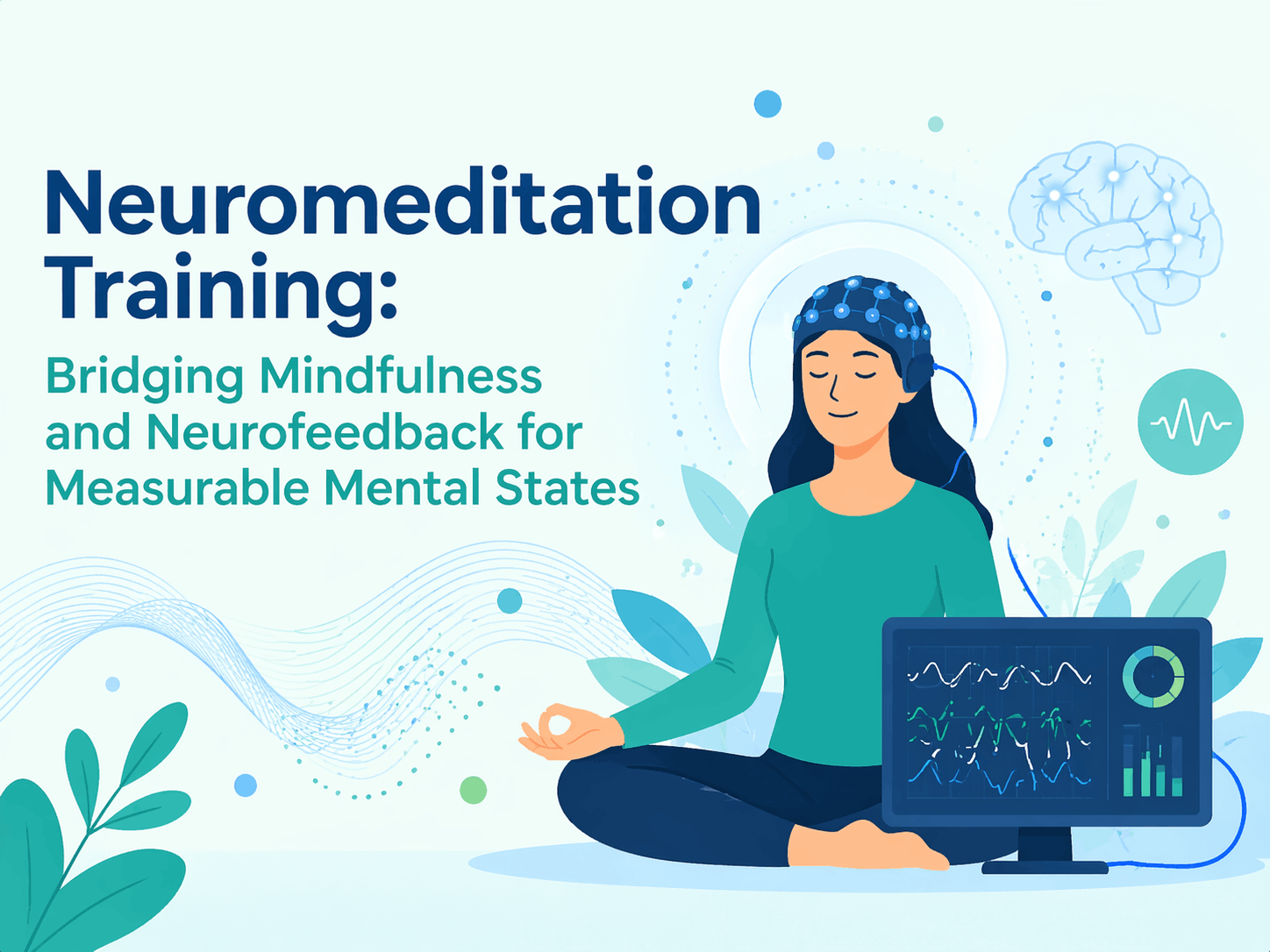
At its core, neuromeditation training is the integration of meditation practices with real-time neurofeedback or biofeedback, which, according to Psychology Today, can be “categorized into four basic styles”: Focus, Mindfulness, Open Heart, and Quiet Mind. Instead of relying solely on your internal sense of awareness, you’re guided by measurable brain activity, typically captured through EEG sensors placed on the scalp. These sensors detect electrical patterns in your brain, allowing software to translate those signals into feedback you can see or hear.
What makes neuromeditation training unique is not just the presence of technology, but the intentional pairing of that technology with specific mental practices. During a session, you might focus on your breath, observe bodily sensations, or cultivate feelings like gratitude while receiving continuous feedback about how your brain is responding. Over time, this creates a direct link between what you feel internally and what is happening neurologically.
It’s also helpful to understand how this differs from related approaches. Traditional meditation relies entirely on subjective awareness, while neurofeedback alone trains brainwaves without necessarily incorporating mindfulness techniques. Neuromeditation training brings these together, creating a feedback loop between attention, intention, and measurable brain activity. The result is a more structured way to develop mental states that were once difficult to quantify.
The Science Behind Neuromeditation
To understand why neuromeditation training works, it helps to look at the brainwaves involved in meditation. When you’re engaged in focused thinking, your brain typically produces beta waves. As you relax and shift into a more calm but alert state, alpha waves become more prominent. Deeper meditative states are often associated with theta activity, which has been linked to creativity, memory processing, and emotional integration.
Research in neuroscience has shown that meditation can influence these patterns, but without feedback, it can take years to reliably access them. In fact, in their workAltered Traits: Science Reveals How Meditation Changes Your Mind, Brain, and Body, Daniel Goleman and Richard J. Davidson suggest that it usually takes 10 or more years to experience lasting change or altered traits from traditional meditation alone. In contrast, neuromeditation training shortens that process by giving you immediate information about what your brain is doing. For example, if your goal is to increase alpha activity, the system can reward your brain when it moves in that direction, reinforcing the pattern through learning mechanisms tied to neuroplasticity.
Neuroplasticity, the brain’s ability to reorganize itself by forming new neural connections, is a well-established concept in neuroscience (see this review from the National Institutes of Health). Neuromeditation training leverages this neuroplastic capacity by pairing intentional mental states with feedback, allowing your brain to learn more efficiently than it would through repetition alone.
This process also aligns with findings on stress and emotional regulation. Studies have shown that meditation can reduce activity in brain regions associated with stress while strengthening areas involved in attention and self-regulation (for example, research published by Frontiers in Human Neuroscience ) Neuromeditation training builds on this foundation by making those shifts visible and trainable.
How Neuromeditation Training Works in Practice
In a typical neuromeditation training session, you begin by placing sensors on your scalp, which are connected to a system that reads your brainwave activity. Before the meditation starts, the system records a baseline, giving you a reference point for how your brain is functioning at rest. This step is important because it allows the training to be tailored to your unique patterns rather than relying on generic assumptions.
Once the session begins, you’re guided through a specific meditation protocol, such as those provided in NewMind’s neuromediation training protocol: Focus, Mindfulness of Body, Quiet Mind, Open Heart, or Deep States. During a session you might focus your attention on your breath, observe sensations in your body, or cultivate a particular emotional state such as appreciation or calm. At the same time, the system provides real-time feedback, often in the form of sounds, visuals, or subtle cues that respond to your brain activity.
As you continue, your brain starts to recognize which patterns are being reinforced. If your activity shifts toward the desired state, the feedback becomes more favorable, encouraging your brain to maintain that pattern. Over repeated sessions, this creates a learning loop where your brain becomes more efficient at entering and sustaining those states.
What makes this process particularly effective is its adaptability. Protocols can be adjusted based on your goals, whether you’re working on focus, emotional regulation, or deeper meditative states. This flexibility is one reason neuromeditation training is used in both clinical settings and at home, offering a scalable approach to mental training.
Key Benefits of Neuromeditation Training
Although neuromeditation practitioners experience many benefits, for the purposes of this discussion we’ll focus on a few of the more common ones.
Faster Skill Acquisition
One of the most immediate advantages of neuromeditation training is how quickly you begin to understand what different mental states feel like. Instead of relying on guesswork, you receive continuous feedback that helps you recognize when you’re on track. This accelerates the learning process and reduces frustration, especially for those who have struggled with meditation in the past.
Objective Progress Tracking
Another major benefit is the ability to track progress over time. Because your brain activity is being measured, you can see changes in patterns related to relaxation, focus, or emotional stability. This data-driven approach provides a level of clarity that traditional meditation does not offer, making it easier to stay motivated and consistent.
Improved Emotional Regulation
Neuromeditation training also supports emotional balance by helping you train brain states associated with calm and resilience. As you become more familiar with these states, you’re better able to access them in everyday situations. This can be particularly helpful in managing stress, as explored in work on alpha brainwave training such as our previous overview of alpha waves and neurofeedback.
Enhanced Focus and Cognitive Performance
By strengthening attention networks, neuromeditation training can improve your ability to concentrate and sustain focus. This is not limited to meditation sessions; the effects often carry over into work, learning, and other areas of daily life.
Clinical Applications
In clinical contexts, neuromeditation training is being used to support individuals dealing with stress, anxiety, attention challenges, and trauma. While it’s not a standalone solution, it can be a valuable component of a broader treatment approach, offering a structured way to train the brain toward more adaptive patterns.
Neuromeditation vs. Traditional Meditation: What Changes?
It’s important to remember that when you compare neuromeditation training to traditional meditation, the core principles remain the same. You’re still working with attention, awareness, and intentional mental states. What changes is the level of feedback and precision available to you.
Traditional meditation often involves trial and error, where progress is felt but not easily measured. Neuromeditation training, on the other hand, provides a data-informed process that helps you refine your practice more efficiently. This does not replace meditation; it enhances it by giving you additional information about what is happening beneath the surface.
For those who are skeptical, it might be helpful to think of neuromeditation training as a tool rather than a replacement; It doesn’t change the nature of meditation itself, but it does change how quickly and clearly you can learn it.
Who Can Benefit from Neuromeditation Training?
The short answer? Almost everyone. Neuromeditation training isn’t limited to a specific group of people. Clinicians can use it to expand their services and offer more structured interventions, while individuals can use it to deepen their personal practice. What’s more, it’s especially valuable for those who have found traditional meditation difficult to maintain or understand.
High performers are also increasingly drawn to a neuromeditation approach because it offers a way to optimize focus and mental clarity. At the same time, individuals who simply want measurable outcomes often find it more engaging than traditional methods. In short, whether used in a clinic or at home, neuromeditation training provides a flexible framework that can be adapted to different goals and environments.
The Future of Meditation Is Measurable
As technology continues to shape how each of us understands and interacts with our own minds, neuromeditation training represents a powerful step forward. It bridges the gap between subjective experience and objective data, allowing you to train your mind with greater clarity and intention and see measurable results faster than traditional meditation practice.
At its core, this approach reframes meditation as a skill that can be learned, refined, and tracked over time. When you combine awareness with measurement, you move beyond uncertainty and into a more structured and indeed even practical process of growth. That shift is already influencing how clinicians and individuals approach mental health and performance.
If you’re curious about how neuromeditation could fit into your own practice or professional work, you can explore the tools that make this possible through NewMind’s platform here:
By taking that next step, you move from simply experiencing meditation to actively training your brain to achieve it.

Dr. Lynn Langmade
Lynn is an award-winning marketer with over 20 years of experience in technology and healthcare industry, specializing in high-growth startups and Fortune 500 companies like Johnson & Johnson and Kaiser Permanente. With a doctorate in English, she combines deep writing and research expertise to tell compelling stories.