

Cognitive Performance Testing: Adding Value to Your Clinic
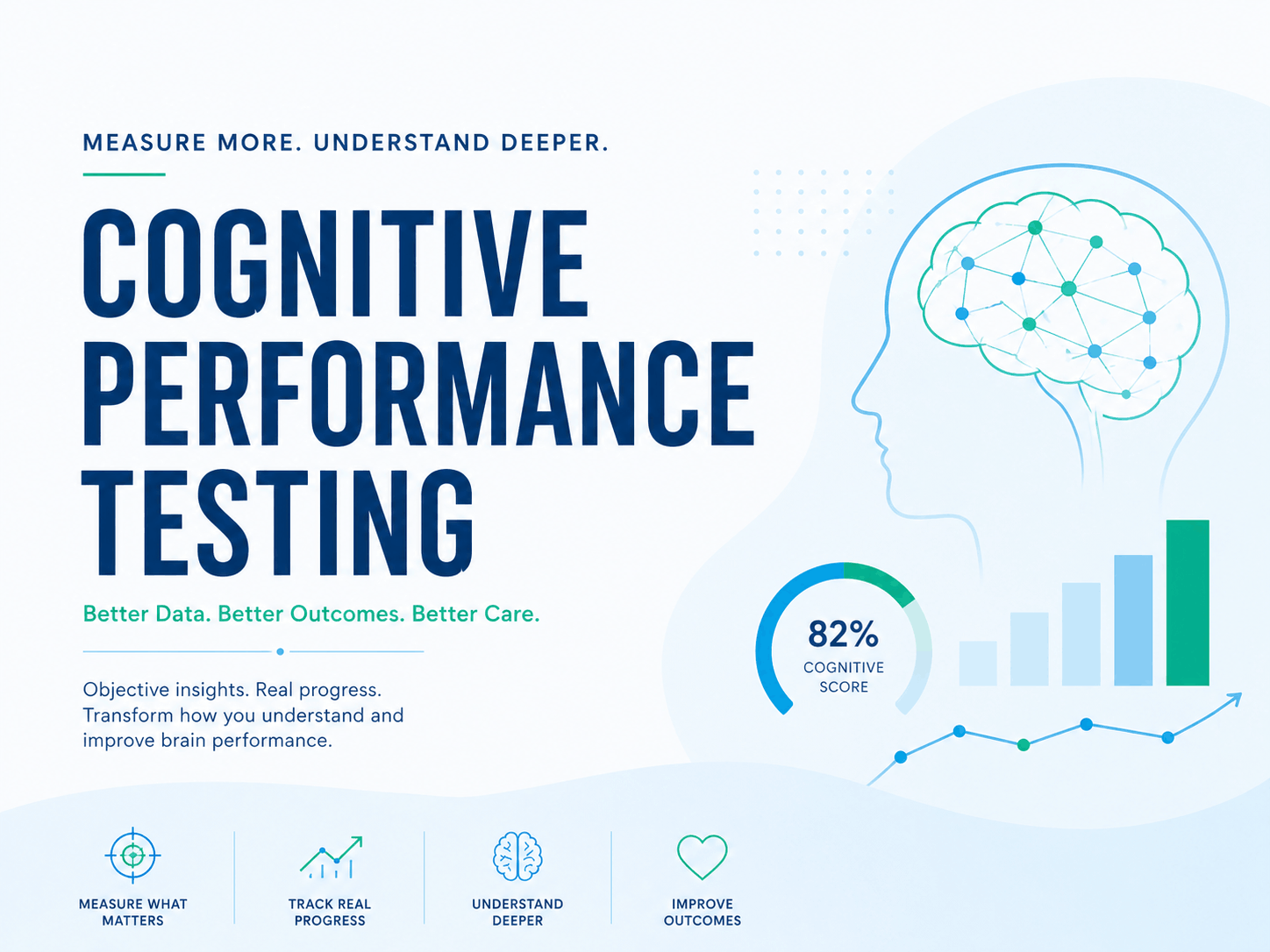
Cognitive performance testing tools are a lot like the dashboard in your car. You can drive without it—you might even get where you’re going—but you’re doing it without clear feedback on speed, fuel levels, or whether something under the hood needs attention. Most people wouldn’t choose to drive that way, yet that’s exactly how many clinics still operate when they rely only on subjective reports to track progress.
Your clients may tell you they feel better, more focused, or less anxious, but without objective data, those improvements can be hard to define and even harder to sustain. Over time, that lack of clarity can create quiet doubt, especially for clients who are used to seeing metrics in nearly every other area of their lives. When you introduce cognitive performance testing, you change that dynamic. Now, instead of guessing, you’re measuring.
When paired with approaches like neurofeedback, cognitive testing becomes more than a supporting tool. It gives you a way to connect what your clients are experiencing with what’s actually happening in their brain, creating a clearer, more grounded picture of progress from the very beginning. As explored in NewMind’s post on peak performance training, optimizing brain function requires both insight and measurement—and cognitive testing provides both.
For the remainder of this post, we’ll show how cognitive performance testing tools can strengthen both the clinical and business sides of your practice. We’ll also walk through how these tools can improve client engagement, enhance neurofeedback outcomes, and create a more structured, data-driven experience from intake to re-evaluation. By the end, you’ll have a clear sense of how these tools fit into your workflow and why they’re quickly becoming part of the standard for modern clinics.
Why Cognitive Performance Testing Tools Matter More Than Ever
As your clinic begins to move toward a more data-informed approach, one shift becomes increasingly clear. Client expectations have evolved alongside the broader culture of tracking, measurement, and performance optimization. People are no longer satisfied with general explanations or vague assurances; they want data that helps them understand how their brain is functioning and how it’s changing over time.
But without cognitive testing, your ability to communicate progress is limited. You might describe improvements in attention or emotional regulation, but those descriptions can feel abstract. When you incorporate testing, you bring clarity to those conversations, showing measurable changes in reaction time, working memory, and processing speed: domains that are foundational within cognitive neuroscience.
What makes these measurements so valuable is not just that they are objective, but that they translate directly into how your clients function in their everyday lives. These domains are not theoretical. Indeed, they succeed in influencing how someone focuses during a meeting, manages stress in real time, or processes information under pressure. Research from institutions like the National Institutes of Health reinforces how cognitive functions such as attention and memory shape everything from productivity to emotional regulation. When clients can see these changes reflected in their own data, the impact becomes tangible.
From Subjective Experience to Objective Insight
One of the most common challenges in clinical work is bridging the gap between how a client feels and what can be demonstrated. Clients may report improvement, but without structure, that improvement can feel uncertain or inconsistent.
Cognitive performance testing tools address this directly. By establishing a baseline and tracking progress over time, you create a framework that turns subjective experience into objective insight. Each assessment builds on the last, creating a clear trajectory that both you and your client can follow.
This approach mirrors broader clinical standards, where measurement is central to evaluating outcomes. It also aligns with best practices in behavioral health and performance optimization, where consistent data collection leads to more informed decisions.
How Cognitive Performance Testing Tools Enhance Neurofeedback
If you already offer neurofeedback, cognitive testing doesn’t complicate your process—it strengthens it.
While cognitive performance testing has existed for over a century, its role in everyday clinical practice is relatively recent. Early assessments were largely confined to research labs and specialized neuropsychological settings, where they were time-intensive and impractical for routine use. As outlined by the National Institutes of Health, advances in digital assessment tools have made it possible to measure core functions like attention, memory, and processing speed in a more standardized and accessible way. Over the past decade, this shift has allowed cognitive performance testing to integrate seamlessly into clinical workflows, helping bridge the gap between brain activity and real-world performance in a way that is both measurable and actionable.
Accordingly, neurofeedback works by helping the brain learn more efficient patterns of activity, but without complementary data, it can be difficult to demonstrate how those changes translate into real-world performance. Cognitive testing fills that gap by providing measurable indicators of improvement.
For example, a client working on focus can show measurable gains in attention consistency. Another client addressing stress-related challenges may demonstrate improvements in processing speed or cognitive flexibility. These are not abstract outcomes. Rather, they are quantifiable shifts that reflect meaningful change.
Our foundational post on functional neurofeedback explains how individualized protocols are built around brain activity. Cognitive testing adds another layer to that personalization by showing how those changes impact performance in daily life.
Cognitive Performance Testing Tools as a Growth Driver
The value of cognitive testing extends beyond clinical outcomes—it also plays a role in how your practice grows.
Testing creates a natural entry point for new clients. Some individuals may hesitate to commit to a full training program, but they are willing to begin with an assessment. Once they see their results, they often gain a clearer understanding of what’s possible, making the next step feel more natural.
It also increases perceived value. When clients can see measurable progress, they are more likely to stay engaged and more likely to refer others. They can describe their experience in concrete terms, which makes your services easier to understand and share.
In a competitive market, that clarity matters. Clinics that use cognitive performance testing tools position themselves as structured, data-informed, and results-oriented.
Designing a Better Client Experience
Integrating cognitive testing into your workflow improves the client experience from the very first interaction.
The initial assessment becomes a moment of insight. Clients begin to understand how their brain functions in a way that feels both personal and actionable. This often increases engagement because it taps into natural curiosity.
Follow-up assessments reinforce that engagement. Each data point contributes to a larger story, showing how the brain is adapting and improving over time. This creates continuity in the client experience and helps maintain momentum.
The broader healthcare landscape is moving in this direction as well. Organizations like the WHO emphasize the importance of personalized, measurable care in improving outcomes. Cognitive testing aligns naturally with that model.
What to Look for in Cognitive Performance Testing Tools
Choosing the right tools is what ultimately determines whether this approach works in practice. You want assessments that are grounded in science but also practical to administer. If the process is too complex, it becomes difficult to integrate into your workflow, but if it’s overly simplified, it may not provide meaningful insight.
Focus on systems that measure core cognitive domains such as attention, memory, processing speed, and executive function. These areas are widely recognized and directly connected to the concerns your clients bring into your clinic.
Equally important is how results are presented. Clear, visual reporting makes it easier for clients to understand their data, which increases engagement and builds trust over time.
How NewMind’s Cognitive Performance Testing Works in Practice
Once you understand what to look for, the next question becomes how these elements come together in a real clinical setting. This is where implementation matters just as much as theory.
NewMind approaches cognitive performance testing as part of a fully integrated system rather than a standalone tool. From the start, you’re combining cognitive assessments with qEEG brain mapping, symptom tracking, and functional neurofeedback protocols. These data points are not treated separately—they work together to give you a more complete picture of how your client is functioning across cognitive and emotional domains.
As outlined by the National Institutes of Health, cognitive functions such as attention, memory, and processing speed are central to how individuals perform in everyday life. NewMind builds on this foundation by allowing you to measure those domains directly and track how they change over time alongside neurofeedback training.
In practice, this means you can establish a baseline, implement targeted protocols, and then reassess using the same structured metrics. Over time, you’re able to connect changes in brain activity with measurable improvements in cognitive performance, creating a clear and repeatable process that both you and your client can follow.
Just as important, the system is designed to fit into your workflow. Assessments are streamlined, repeatable, and paired with visual reporting that makes it easy to communicate results. Instead of translating raw data, you’re showing clients exactly how their performance is evolving, which reinforces engagement and supports long-term retention.
A New Standard for Modern Clinics
As more clinics adopt cognitive performance testing tools, expectations continue to evolve.
What once felt like an advanced offering is becoming part of the standard of care. Clients are beginning to expect measurable insights, not just general observations.
This shift doesn’t require a complete overhaul of your practice. Instead, it offers a path to evolve in a way that aligns with where the field is already heading. By combining neurofeedback with cognitive testing, you create a model that is both data-driven and client-centered.
Turning Insight into Action
In short, cognitive performance testing tools do more than add another service to your clinic. They actually change how you deliver care. You’ll move from explaining outcomes to showing them, from estimating progress to measuring it, and from offering sessions to guiding a clearly defined process.
That shift has a ripple effect. Clients gain confidence, engagement improves, and your clinic becomes easier to differentiate in a crowded market. At the same time, you align your practice with a model of care that prioritizes both personalization and measurable results.
If you’re ready to take that next step and adopt the standard for all modern clinics, NewMind’s Cognitive Performance Testing platform is designed to integrate seamlessly into your workflow while providing the clarity and data your clients are already looking for.
The real question isn’t whether cognitive testing adds value—it’s how much value you’re missing without it.

Shawn Bearden
Shawn Bearden is the CEO and co-founder of NewMind Technologies, where he leads the development of neurofeedback software designed to simplify and scale brain-based training. With experience in software engineering, technology, and business strategy, he focuses on creating systems that bridge neuroscience and practical clinical use. His writing explores the intersection of neurofeedback, mental health innovation, and emerging treatment models, including trauma recovery, PTSD, and psychedelic-assisted therapy. Shawn is particularly interested in how these approaches can work together to improve outcomes and expand access to effective care.