

Rethinking Peak Performance: Training Your Brain for the Moments That Matter Most
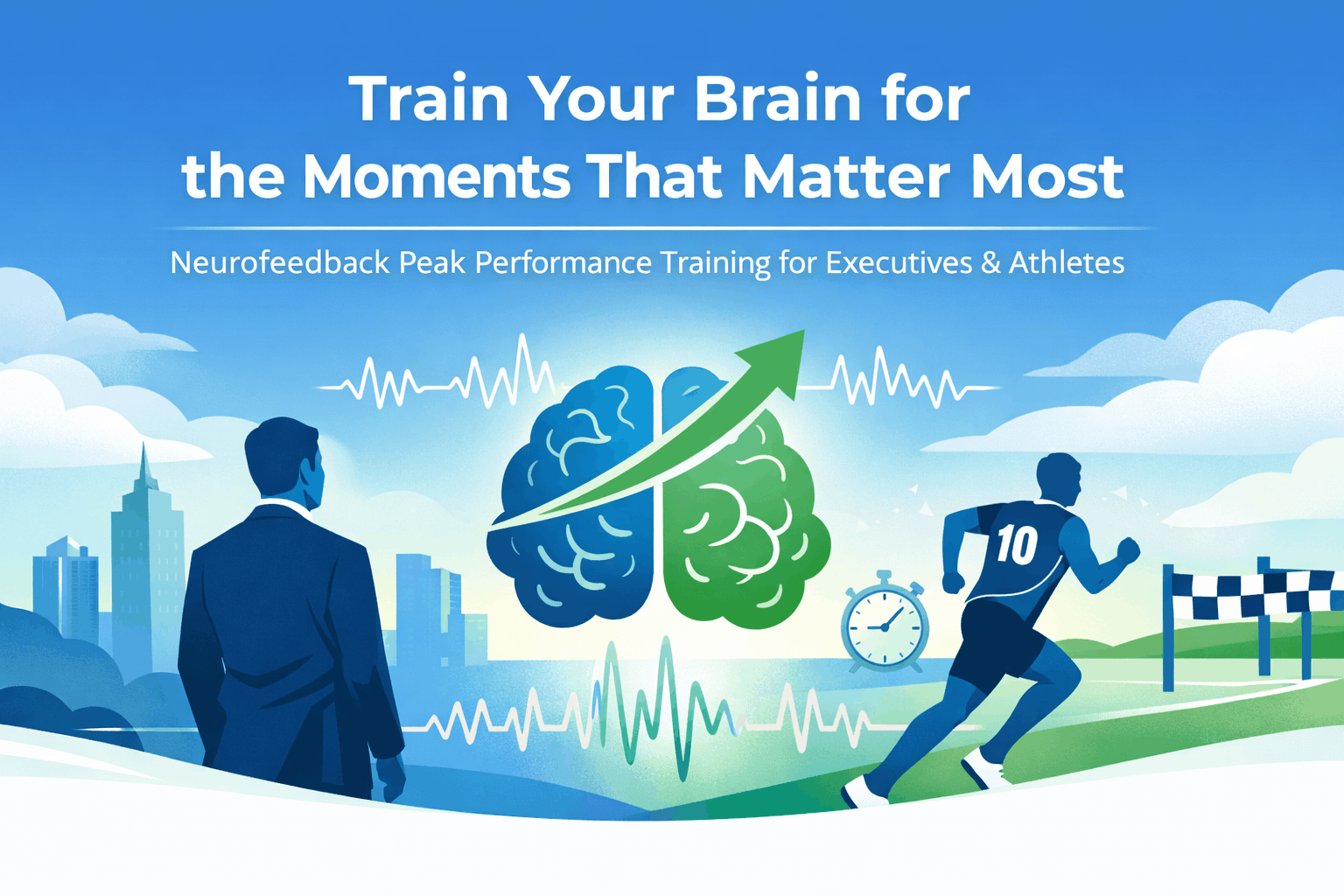
There’s a moment you recognize immediately, whether you’re in a boardroom or on a field—the moment when everything is on the line, and your next decision matters more than the last hundred combined. Sometimes you rise to it with clarity and precision. Other times, your focus slips just enough to change the outcome.
Neurofeedback peak performance training is built around one central question: what if you could train your brain to show up at its best in those exact moments, not just occasionally, but consistently?
You’ve likely experienced brief windows where your thinking felt sharper, your reactions faster, and your confidence steadier. The challenge isn’t accessing that state once; it’s being able to return to it when pressure builds. As we argued in our post peak performance neurofeedback, the brain can be trained to stabilize these high-functioning states, rather than leaving them to chance.
Throughout this post, we’ll come back to that defining moment—the high-stakes decision, the critical play, the instant where performance either holds or breaks—and examine how training your brain directly changes what happens when you get there.
What Happens in the Moment That Matters Most
When that high-pressure moment arrives, your brain doesn’t suddenly become more capable. It reveals the patterns it has already learned. If your nervous system is dysregulated, your thinking narrows. If your brain is balanced and responsive, you remain flexible, aware, and decisive.
Psychological research on optimal performance shows that peak performance is tied to your ability to regulate attention and emotional response under stress—not eliminate stress altogether. For example, a review in Frontiers in Behavioral Neuroscience on choking under pressure and its neuropsychological mechanisms explains how pressure can disrupt attention and working memory in ways that directly affect performance.
Neurofeedback peak performance training focuses on that exact shift. Instead of trying to control external variables, you begin training the internal systems that determine how you respond when the pressure hits.
Neurofeedback Peak Performance Training: Rewiring Performance at the Source
At its core, neurofeedback peak performance training works by giving your brain real-time information about itself. Sensors measure brainwave activity, and that data is fed back to you through visual or auditory cues. Over time, your brain begins to recognize which patterns support clarity and which lead to distraction or overload.
This process is grounded in decades of neuroscience research. Studies on neuroplasticity, including work published through the National Library of Medicine, show that the brain can reorganize itself in response to training and feedback over time. Instead of forcing focus through effort alone, you’re teaching your brain how to sustain it more efficiently. That distinction becomes especially clear in high-pressure situations, where effort alone often breaks down.
So when you return to that defining moment, i.e., the negotiation, the competition, the decision, you’re no longer relying on willpower. You’re relying on trained neural patterns.
Why Executives Lose Clarity Under Pressure and How to Change It
In executive environments, the defining moment often looks like a decision with incomplete information and real consequences. You’re expected to process complexity quickly, communicate clearly, and remain composed while others are reacting.
The problem is that chronic stress changes how your brain functions. Research on stress and cognition, including findings summarized by Harvard Health Publishing, shows that prolonged stress can impair memory, reduce cognitive flexibility, and shift decision-making toward more reactive patterns.
That’s why even experienced leaders can find themselves second-guessing or mentally fatigued at the worst possible times.
Neurofeedback addresses this by helping your brain regulate its stress response more effectively. Over time, you begin to notice that the same situations that once triggered tension now feel more manageable. And when that critical moment arrives, your thinking remains intact instead of narrowing under pressure.
How Athletes Train for the Same Moment
For athletes, the defining moment is often more visible but no less complex. It’s the final seconds of a game, the execution of a precise movement, or the ability to stay composed after a mistake. Traditional mental training methods, such as visualization, repetition, focus drills, have long been used to prepare for these moments. Neurofeedback builds on those methods by giving you direct insight into the brain activity that supports them.
When you train your brain to maintain optimal patterns, you improve not only focus but also recovery. That’s especially relevant when you consider how factors like oxidative stress can affect cognitive performance over time. So when you step into that defining moment again, you’re not just prepared physically: you’re neurologically prepared as well.
One Brain, Two Worlds: Why the Same Training Applies
What becomes clear is that the executive and the athlete are solving the same problem. Both are trying to maintain clarity, control, and responsiveness when it matters most. But neurofeedback doesn’t separate these roles. It simply trains the underlying systems that drive performance in both. Whether you’re making a strategic decision or executing a physical movement, your brain is responsible for coordinating attention, emotion, and action.
And when those systems are trained effectively, the defining moment begins to change. It becomes less unpredictable and more manageable, less about reacting and more about executing.
Changing What Happens When It Counts
That moment where everything is on the line doesn’t go away. If anything, it becomes more frequent as your responsibilities and ambitions grow.
What changes is how you meet it.
Neurofeedback peak performance training gives you a way to prepare for those moments at the level where performance actually begins: the brain itself. Instead of hoping your focus holds, you train it to. Instead of reacting under pressure, you learn to stay composed within it. And over time, those moments that once felt uncertain start to feel familiar because your brain has been there before, and it knows what to do.
If you’re ready to train for the moments that matter most, you can explore how this approach is applied in practice through NewMind’s platform:

Dr. Lynn Langmade
Lynn is an award-winning marketer with over 20 years of experience in technology and healthcare industry, specializing in high-growth startups and Fortune 500 companies like Johnson & Johnson and Kaiser Permanente. With a doctorate in English, she combines deep writing and research expertise to tell compelling stories.