

Alpha Theta Training Protocols in Practice: A Step-by-Step Guide for Neurofeedback Clinicians
Introduction
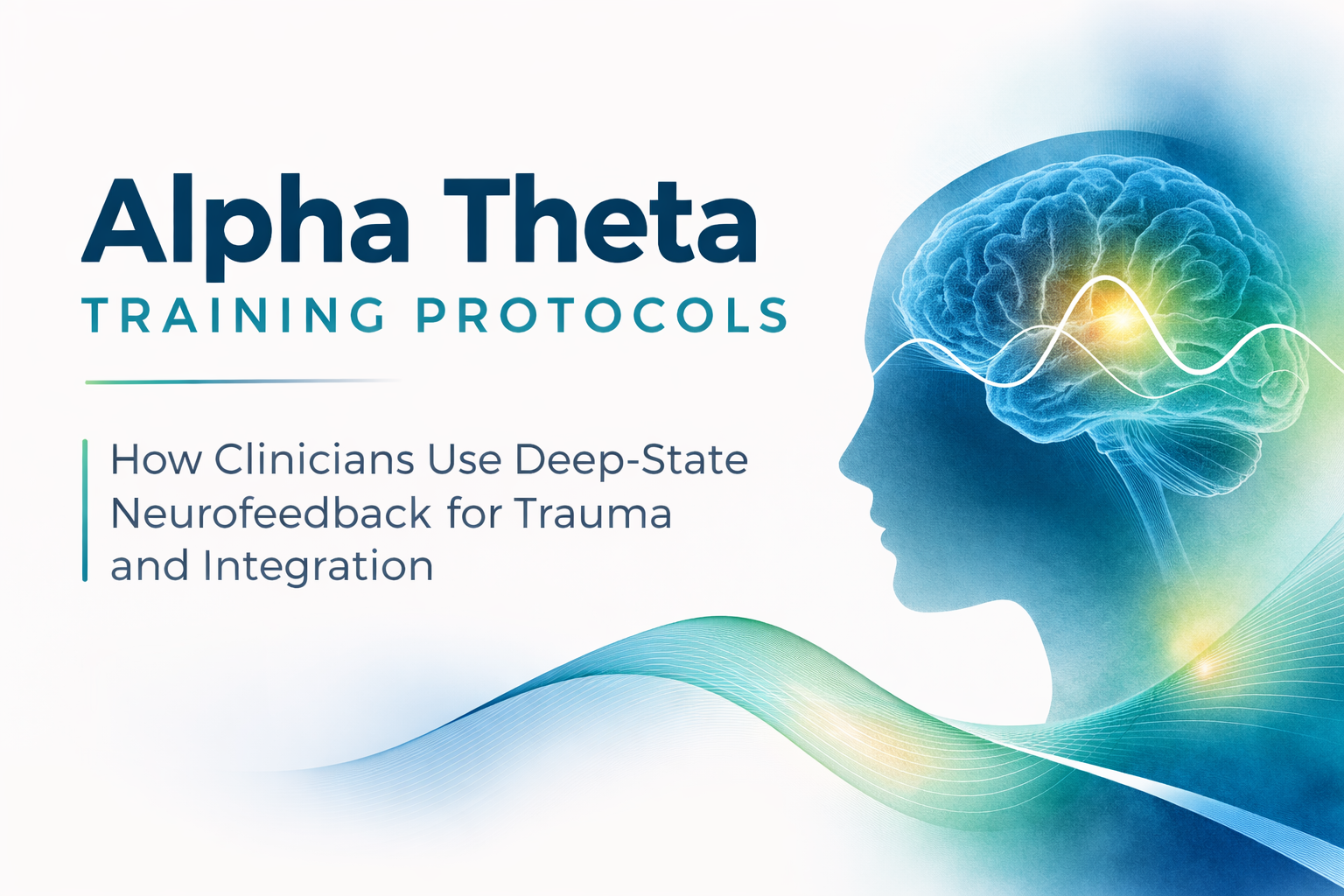
Alpha theta training protocols have become one of the most recognized neurofeedback approaches for addressing trauma, emotional dysregulation, and deeply rooted behavioral patterns. When you incorporate this training method into your clinical work, you’re not simply guiding the brain toward new activity patterns—you’re helping clients access mental states associated with introspection, memory integration, and emotional processing.
Many clinicians first encounter alpha theta training when studying trauma work or reviewing research on altered states of consciousness in therapy. Early clinical work on alpha theta neurofeedback demonstrated promising results in trauma and addiction treatment, particularly in the foundational study by Peniston and Kulkosky published in Alcoholism: Clinical and Experimental Research (Peniston & Kulkosky, 1989). Over time, clinicians discovered that this protocol could help clients move beyond surface-level symptom management and toward deeper psychological integration.
Yet while the concept is widely discussed, many providers still ask a practical question: How do you actually implement alpha theta training protocols in a structured clinical setting? Throughout the remainder of this post, we’ll show how alpha–theta neurofeedback works, when it is most appropriate to use, and how to implement training protocols in a way that supports both safety and therapeutic progress. Along the way, you’ll also be able to also see how this work connects to broader neurofeedback concepts such as alpha and theta brainwave activity.
Understanding Alpha and Theta Brainwave States
Before implementing alpha theta training protocols, it helps to understand the brain states involved. Alpha and theta rhythms represent two distinct but complementary ranges of brainwave activity. Alpha waves are associated with relaxed awareness and meditative states, often appearing during calm wakefulness or meditation. Theta waves, by contrast, tend to emerge during deeper internal states such as dreaming, memory processing, and emotional imagery.
A detailed overview of these frequency ranges can be found in NewMind’s explanation of alpha brainwaves. Moreover, neurofeedback clinicians often examine several frequency bands simultaneously because each rhythm contributes to different aspects of cognition and emotional regulation. A broader overview of these different brainwaves provides a broader explanation of how various frequency bands influence cognition and emotional states.
During alpha–theta training, the goal is to help the client gradually increase theta activity relative to alpha activity, encouraging a transition into a deeply relaxed and introspective state. Rather than forcing the brain into this condition, neurofeedback uses real-time feedback to reward subtle shifts in brainwave patterns, allowing the client’s nervous system to move naturally toward deeper internal awareness. As theta activity increases and alpha rhythms remain present for stability, many clients begin to enter a state similar to the threshold between wakefulness and sleep. In this condition, mental imagery, emotional insight, and memory processing often become more accessible. For clinicians, the objective is not simply to achieve a particular brainwave ratio, but to support a brain state where relaxation, reflection, and emotional integration can occur safely and comfortably.
Researchers studying neurofeedback and self-regulation have noted that these states may support emotional processing and memory reconsolidation, which helps explain why they’re frequently used in trauma-focused work. Studies published through the National Institutes of Health describe how neurofeedback can influence self-regulation networks within the brain when feedback is delivered in real time. But it’s important to recognize that as a clinician, you’re not forcing the brain into a new state. Instead, you’re creating conditions where the brain learns to shift naturally through feedback and reinforcement.
Alpha Theta Training Protocols in Clinical Practice
Preparing the Client for Deep-State Training
Alpha theta training protocols differ from many traditional neurofeedback approaches because they often guide the client toward a deeply relaxed, inwardly focused state. For that reason, preparation matters.
Clients typically begin in a comfortable reclined position, often with eyes closed. The environment should feel quiet and supportive. Clinicians use gentle auditory feedback tones rather than visually stimulating displays, since the goal is to encourage internal awareness rather than external attention.
In many cases, alpha–theta sessions occur after the client has completed other neurofeedback training designed to stabilize attention, emotional regulation, or baseline brainwave patterns. This sequencing is intentional because only after you help the client’s brain build stronger self-regulation skills, can they enter alpha–theta states more comfortably and safely.
Electrode Placement and Signal Monitoring
Alpha theta training protocols typically involve a single-channel electrode placement at the occipital region, most commonly at sites Pz, P4, O1 or O2 according to the International 10–20 EEG system. These regions of the brain are associated with visual processing and internally generated imagery, which makes it particularly well suited for alpha–theta work. Because many clients report vivid mental imagery, memories, or symbolic experiences during deep-state training, monitoring activity in the occipital area allows clinicians to track the brainwave patterns most closely connected to these internally focused states. During the session, the neurofeedback system continuously monitors the relative amplitude of alpha and theta activity and provides real-time feedback when the client’s brain begins shifting toward the target state.
As training progresses, feedback encourages the client to gradually increase theta activity while maintaining enough alpha activity to preserve emotional stability and relaxed awareness. The objective is not to abruptly push the brain into a theta-dominant condition, but to guide it gently toward deeper relaxation and introspection through incremental reinforcement. While the software manages the signal and feedback parameters, the clinician’s role extends well beyond technical oversight and involves walking clients through a visualization. Some clients describe vivid imagery or memory recall, while others report drifting sensations similar to the threshold between wakefulness and sleep. Both responses are common and may reflect the brain entering a state where emotional processing becomes more accessible. Research has also suggested that neurofeedback may produce stronger outcomes when it is integrated with structured psychological approaches rather than used as a standalone intervention. A systematic review examining neurofeedback combined with therapies such as cognitive-behavioral therapy and mindfulness found preliminary evidence that integrated treatment approaches can improve outcomes for conditions such as anxiety, depression, and stress (Molaeizadeh et al., 2025).
Reinforcement and Threshold Adjustment
Reinforcement thresholds play a central role in any neurofeedback training protocol, and alpha–theta training is no exception. In this approach, thresholds are typically adjusted to encourage a gradual rise in theta activity relative to alpha activity while maintaining a stable and relaxed mental state. The neurofeedback system monitors these shifts continuously and delivers auditory or visual feedback when the brain begins moving toward the desired pattern. Over time, this reinforcement helps the client learn how to access deeper states of relaxation and internal awareness through self-regulation rather than conscious effort.
Many alpha–theta systems also track the moment when theta amplitude surpasses alpha amplitude, a transition commonly referred to as the “crossover.” Clinicians often view this crossover as an indicator that the client has entered a deeper introspective state, where imagery, emotional processing, or memory recall may become more accessible. However, the crossover should not be treated as a rigid objective that must occur in every session. In the early stages of training, many clients benefit from remaining in a predominantly alpha-dominant state, where relaxation is present but the mind remains anchored and stable. Attempting to push the brain too quickly into deeper theta states can sometimes create discomfort or emotional overwhelm, particularly for clients new to neurofeedback.
For this reason, thoughtful threshold adjustments are essential. From a clinical standpoint, the goal is not to chase isolated signals or single-session outcomes. Instead, you’re observing patterns that develop across multiple sessions. Over time, many clients begin to demonstrate an improved ability to access calm, reflective mental states and to remain present with internal experiences without becoming overwhelmed. These gradual changes often signal that the training is supporting meaningful shifts in emotional regulation and self-awareness.
Integrating Alpha Theta Work Into Trauma Treatment
One of the most common clinical applications of alpha theta training protocols involves trauma treatment. Trauma can disrupt the brain’s ability to regulate emotional and memory networks. As a result, clients may experience intrusive thoughts, hyperarousal, or difficulty integrating past experiences.
Alpha–theta neurofeedback may support the therapeutic process by helping the brain enter states associated with emotional processing and memory integration. NewMind’s post on alpha theta neurofeedback for trauma explains how this training approach is often used alongside trauma-informed therapeutic methods.
In practice, clinicians frequently combine alpha–theta training with psychotherapy, mindfulness techniques, or trauma processing frameworks. The neurofeedback session itself does not replace therapy; rather, it helps create mental conditions where therapeutic insights can emerge.This approach reflects a broader understanding of how the brain processes emotional experiences.
Structuring an Alpha Theta Session
Although individual approaches vary, most alpha theta training protocols follow a general structure.
1. Stabilization Phase
Sessions often begin with a brief stabilization period where the client relaxes while the clinician confirms signal quality and baseline activity.
This phase allows both practitioner and client to settle into the session.
2. Training Phase
During training, auditory feedback tones respond to changes in alpha and theta activity.
As the client relaxes more deeply, theta activity may increase, and the system rewards this shift. The experience often feels similar to drifting between wakefulness and sleep.
3. Reflection Phase
After the training period ends, many clinicians invite the client to briefly describe their experience.
Clients may recall imagery, emotions, or insights that arose during the session. These reflections can become useful starting points for therapeutic discussion.
This final step reinforces the idea that alpha–theta neurofeedback is not just a brain training exercise—it can also be part of a broader therapeutic conversation.
When Alpha Theta Training Protocols Are Most Effective
Alpha theta training protocols are often used with clients who have already developed some stability through earlier neurofeedback or therapy work.
Examples include:
- Trauma and post-traumatic stress symptoms
- Addiction recovery
- Emotional regulation challenges
- Performance enhancement for creativity or insight
Because the protocol encourages deep introspective states, clinicians should always consider client readiness.
In some cases, individuals with severe anxiety or unstable mood patterns may benefit from other neurofeedback approaches first. Once regulation improves, alpha–theta training may become a valuable next step.
By approaching the protocol gradually and thoughtfully, you help ensure that the experience remains supportive rather than overwhelming.
The Role of Clinical Judgment
Alpha theta training protocols provide a structured framework, but successful implementation still relies on clinical judgment.
You’re observing more than EEG signals. You’re paying attention to how the client feels before, during, and after the session. Emotional reactions, imagery, or subtle shifts in mood can all provide useful information about how the training is affecting the client.
Over time, you may adjust session length, or therapeutic integration based on these observations.
In this way, neurofeedback remains both a technological and relational practice.
The protocol gives you a tool—but your experience and attentiveness determine how effectively it is used.
From Protocol to Integration
Alpha theta training protocols represent one of the most powerful tools available to neurofeedback clinicians working with trauma, emotional processing, and self-reflection.
By guiding the brain toward relaxed alpha states and gradually encouraging deeper theta activity, you create conditions where introspection and memory integration can occur. When used thoughtfully and integrated with therapeutic support, this approach can help clients move beyond symptom management toward deeper psychological healing.
If you want to explore this method in greater depth, Dr. Richard Soutar’s book Managing and Integrating Trauma with Alpha/Theta Neurofeedback provides an in-depth guide to the theory and clinical practice behind this training approach.
👉 You can explore the book and other professional resources in the NewMind store here:

Dr. Lynn Langmade
Lynn is an award-winning marketer with over 20 years of experience in technology and healthcare industry, specializing in high-growth startups and Fortune 500 companies like Johnson & Johnson and Kaiser Permanente. With a doctorate in English, she combines deep writing and research expertise to tell compelling stories.